When coupled with great service design, digital capabilities can improve the way citizens and business interact with government, strengthen decision making and enhance productivity.
The question, then, is who controls those capabilities and who is accountable for decisions – that is the sovereignty question.
Rather than being a question of ownership, vendor origin or compliance, ‘sovereignty’ is better understood as the ability to retain meaningful control over systems, data, and capabilities where it matters most.
A useful starting point for leaders is to ask: If we lost control of, or access to, this service, system, data, or capability, what would the consequence be, and have we designed our strategy and operating model accordingly?
This question cuts through ideology, focuses attention on risk and opportunity, and supports practical design decisions.
Sovereignty by design requires us to make deliberate choices early in the formation of our strategy and operating model to ensure speed is balanced with trust, resilience, accountability and long-term flexibility.
In this context, ‘sovereignty’ is not a constraint on innovation but a mechanism for ensuring transformation strengthens public confidence, promotes resilience, and preserves control over critical capabilities.
WHY SOVEREIGNTY MATTERS NOW
As platforms, data and AI move closer to the core of how government and critical services are designed, managed and delivered, sovereignty is a critical consideration in any digital transformation.
With this framing, sovereignty matters because public trust is increasingly a key success measure of transformation. Success isn’t just ‘did the system work?’ but rather: ‘do citizens trust the outcome?’
A global study led by the University of Melbourne and KPMG found Australia ranks lowest of all countries surveyed in the belief that the benefits of AI outweigh the risks – just 30% of respondents believe this to be the case.
If organisations are unable to explain decisions, control data and demonstrate accountability, transformation stalls regardless of how fast it was delivered.
Secondly, the risk profile for organisations has fundamentally shifted. Previous transformation waves tended to prioritise efficiency and service digitisation, whereas today’s risk landscape requires us to broaden the parameters of success.
Emerging issues include geopolitical dependencies, vendor concentration, loss of internal capability, and the inability to explain or control AI-driven decisions.
Lastly, an established principle is that digital technologies can amplify the underlying characteristics of a system.
Therefore, if your operating model, services, customer journeys or practices are opaque, fragmented, poorly governed, badly designed or vulnerable, digital transformation will accelerate these challenges whilst making them harder to detect and more consequential.
HOW TO TRANSFORM WITH CONFIDENCE
Agencies doing this well are those moving with intention. When I look at the organisations successfully navigating continuous transformation, four things tend to define them.
First, a genuine strategic anchor. Not just a vision statement, but an articulation of what the department’s unique role is, what the transformation needs to enable, what’s blocking success, and how they will organise themselves to enable the strategy. This provides staff and citizens an anchor when everything else is in motion.
Second, guardrails around data, decision making, and citizen impact are defined upfront. This ensures teams can move seamlessly within established boundaries. As guardrails reflect the values and expectations of the society we serve, understanding why they exist at every level of the organisation is what makes them enduring and effective, rather than being worked around.
Third, modular design or decoupling systems and processes. This ensures new capability can be introduced incrementally, reduces lock-in, and enables organisations to adapt without destabilising critical services. This is advantageous in any environment but especially in government, where legacy platforms, regulatory change, AI adoption, and hybrid hosting increase complexity.
Finally, retained internal capability for functions that are unique to an organisation and require high levels of judgement or decision making. This ensures organisations can understand and control how decisions are made, without depending on external parties to interpret outcomes or decide what comes next.
In short: a poorly defined strategy, operating model mismatch, skills shortages, and diffused accountability slow modernisation more than technology constraints.
UNPACKING THE SOVEREIGNTY MISCONCEPTION
Some leaders enter sovereignty conversations assuming it means owning everything. That can be an unhelpful and expensive assumption!
Trying to make everything ‘sovereign’ leads to over-investment in low-risk areas and under-protection of the capabilities that matter.
The real risk in these ecosystems is unexamined dependency.
You can use global platforms and maintain sovereignty if you design for it. Conversely, you can use local providers and have no sovereignty at all if you’re locked in, lack internal expertise, and can’t change direction when you need to.
So why is it so hard to promote sovereignty when designing and delivering public services?
I believe it is because governments have historically optimised for compliance, service delivery and short term risk reduction. Sovereignty, however, requires long term systems thinking, optionality and strategic restraint.
WHAT DOES SOVEREIGNTY MEAN IN PRACTICE?
Sovereignty is a systems challenge, not an IT issue. As it cuts across law, procurement, architecture, workforce, data governance, supply chains, national security, and democratic accountability. It cannot be delegated to a single function or solved through technology alone.
Rather, it requires orchestration across the whole organisation, clear accountability, and distal thinking about how critical capabilities are designed, governed and sustained.
The benefits of sovereignty can be invisible. Digital transformation has often prioritised efficiency or tangible short term benefits because it is difficult to quantify the risk of dependency, geopolitical exposure, AI lock in or loss of institutional capability. Further, budget cycles can discourage long term design.
Conversely, designing for sovereignty may require greater spending upfront to build modularity and workforce capability, or avoid tightly integrated propriety ecosystems. As noted in Kinetic IT’s inaugural Sovereign Technology Report, “sovereignty is tested during incidents, audits, delivery failures, and geopolitical shocks. It is measured by clarity of accountability, speed and proximity of response, and reliability of recovery.”
For this reason, it is important to challenge any benefits that create systemic fragility.
Capability asymmetry. Industry and society can move much faster than governments can regulate, architect or recruit talent. This challenge is compounded as legacy systems can create dependencies once data models, workflows, systems, tooling and integrations are embedded.
Early in my career, I had the privilege of working with a construction sector leadership team during a downturn in the building industry. Rather than retreating, the executive increased investment in innovation and resilience.
The company thrived in the years that followed. That experience shaped my view that resilience is rarely created in the moment of crisis; it is built earlier, through deliberate choices about where to invest, what to retain and what to protect.
HOW LEADERS CAN EMBED SOVEREIGNTY BY DESIGN
If you are curious about embedding ‘sovereignty by design’ in your organisation, start by answering these five questions.
What is your strategy? The single most important move is to anchor sovereignty in your enterprise and transformation strategy. As ‘Your strategy needs a strategy’ argues, if you can predict your environment and shape it, a visionary strategy may be advantageous. If you can do neither, an adaptive strategy is likely to be more effective. These choices should shape how you think about sovereignty.
What is the unique role your agency plays in the whole of government ecosystem? Together with your enterprise strategy, this should shape what your transformation is intended to enable: faster service delivery, better regulatory outcomes, improved decision making. It should also reflect the values, risks and expectations of the people you serve. Sovereignty must be shaped by your agencies “just cause” – that is the specific vision of an ideal state that inspires people to act.
What’s stopping you from doing that today? In most agencies, the limiting factor isn’t technology but fragmented data, a bias towards short term action, outdated funding models, unclear dependencies and accountabilities, workforce capability gaps, and low trust. Identifying the coordinated actions you must take to remove these barriers progresses a vision into strategy.
How do you organise yourself to enable the strategy? Success is dependent on an intentional operating model. For example, how should our strategy inform governance; ethics; service strategy; commercial and non-commercial partnering; workforce capabilities; culture; data; tools and technologies; and branding.
And the final question, what unexamined vulnerabilities or dependencies do we have? As you design your service strategy within the operating model, use journey maps to identify what can be simplified, streamlined, and, only then, digitised. During this co-design work, ask from as many perspectives as possible: ‘If we lost control of, or access to, this service, system, data, or capability, what would the consequence be?’ The answers will sharpen both your operating model and your investment decisions.
Sovereignty stops being abstract when it is anchored in strategy and expressed through coordinated efforts to identify and address unexamined vulnerabilities.
Do that work well, and sovereignty becomes a practical design principle to build trust, strengthen resilience, improve accountability and flexibility, and retain control where it matters most.
About Jacqui Adams | Follow on LinkedIn
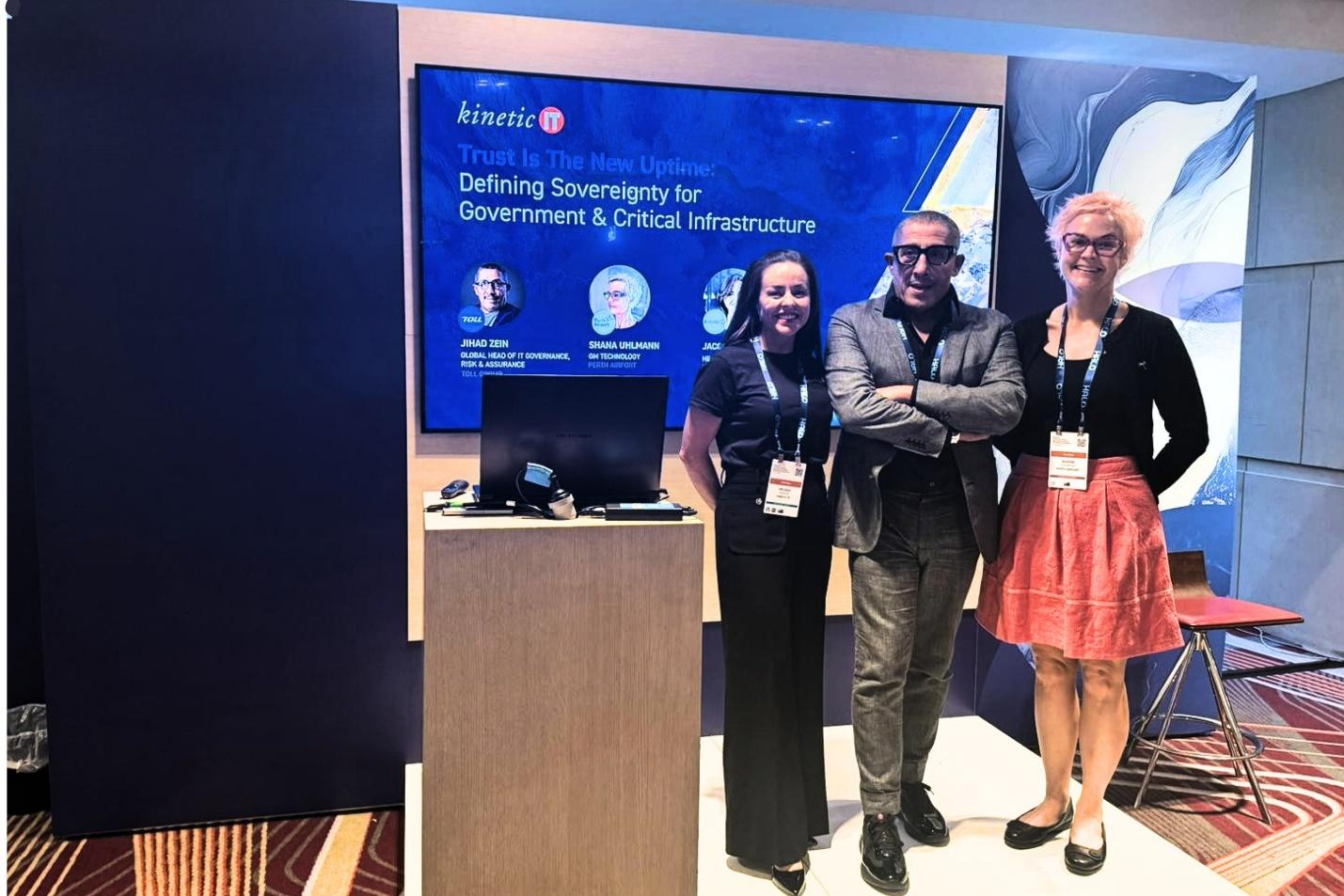
Jacqui Adams is Head of Digital Transformation at Kinetic IT, one of Australia’s largest sovereign managed services providers. She works with government leaders to design transformation strategies that deliver meaningful outcomes for citizens, business and staff, preserve control, and build long-term resilience, and communities. Jacqui spoke about sovereign execution at Gartner IOCS 2026 in the session: Trust Is the New Uptime: Defining Sovereignty for Government and Critical Infrastructure.
Find out more about what we do at Kinetic IT.